

Prison Architect

Prison Architect

评价数不足
Drugs and Alcohol
由 Pedalwerk 制作
A comprehensive guide to dealing with alcohol and drugs in your prison.
   
奖励
收藏
已收藏
取消收藏
Introduction
Addiction to alcohol and / or drugs is a common in-game mechanic. It can quickly spiral out-of-control, making you (the warden) feel powerless to prevent prisoner deaths and reduce reoffending rate. It can feel like you are just putting out the fires rather than fully addressing the problem. This is just like in real life!

This guide will help you to deal with alcohol and drugs in your prison. As with most prison challenges, you can't get rid of them for good: your strategy should evolve over time, and you will need to keep up successful strategies for the next batch of prisoners.
Why care?
Addiction is a major problem for your prison.

Short-term
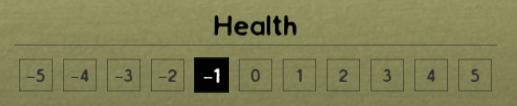
Prisoners can die from overdoses. This can seriously impact your prison's performance. Dead prisoners don't earn you money, and can't be paroled early for a cash bonus. A high death rate can decrease feelings of safety and make your prisoners more violent. When you have "Failure Conditions" enabled, a high death rate can put you at risk of legal liability and losing the game.

Long-term
Prisoners with active addictions have terrible health grading. This substantially increases their reoffending rate. This makes for a worse prison. These prisoners will stay your problem for longer because, with a high reoffending risk, they will not receive early parole. Ultimately, this can lead to a more expensive prison in the long-term, as you will need more resources across the board (more guards and doctors to deal with overdoses, more general staff to do work that addicted prisoners cannot do around the prison in the kitchen and laundry).

As a symptom
Some prisoners arrive to your prison addicted to alcohol or drugs; others become addicted during their stay. Addiction is a symptom of other unmet needs. Unmet needs increases the likelihood that your prisoners will turn to alcohol and drugs to cope with the stress of prison life (akin to real-life).
Assessing the problem
There are lots of metrics for how you're doing on drugs and alcohol (aside from overall reoffending rate and parole rate)

Needs (warden)
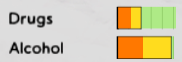
Use the warden's tab to assess needs (requiring at least 1 psychologist). There will be bars for "Drugs" and "Alcohol". The size of the green bars shows you how many prisoners are addicted, and the other colours show you how well you are meeting that need.

Needs (prisoner)
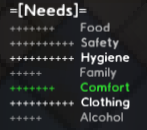
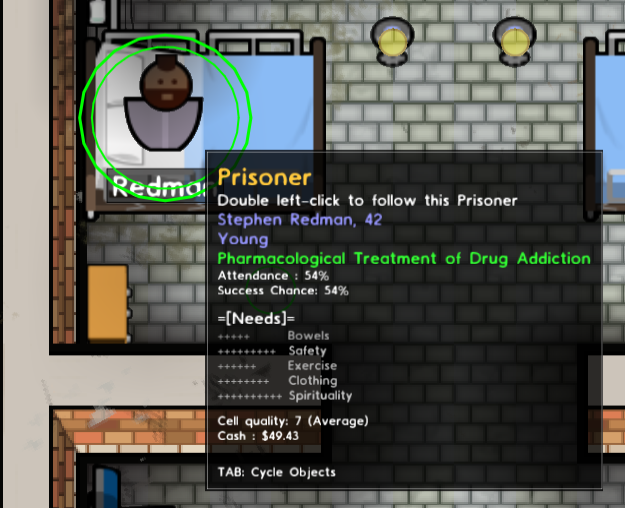
When you click on an inmate, their needs will be listed next to them. "Drugs" and "Alcohol" appear here for them individually. This need is more finely graded on the individual prisoner level than it is in the warden's "Needs" tab. Rarely, you may see the prisoner status "High", which suggests that the prisoner is currently using drugs - send a guard to them immediately to ensure that they get medical help.

Experience
Play 1 in-game day and see how many drug overdoses you get. This is a reactive strategy, and so suboptimal, but is also more practical (you have lots of priorities as prison architect, and drugs and alcohol cannot always be your top priority given that addictions affect a minority of your prisoners).

Supply and demand
Look at contraband supply and demand. High demand indicates a problem. This gives a very general overview. Many prisoners will want booze (even if they are not dependent) as it is a luxury, so this may also overestimate the true amount of addiction.
Pharmacological treatment of drug addiction
Pharmacological treatment of drug addiction is a program that can cure drug addiction and suppress demand for drugs as contraband. It is a cheap and effective way to reduce drug addiction in your prison, and should be available to all prisoners who need it.

Requirements
  • "Health", unlocked through "Bureaucracy" (requiring the warden)
  • An infirmary (with at least a few beds) that prisoners can access
  • A doctor, unlocked through "Bureaucracy" at the same time as "Health"

Logistics
  • Each session costs $200, and lasts 1 hour.
  • Each prisoner will need a bed - you can only treat as many patients as you have hospital beds.
  • The maximum size of the program is 10 prisoners for each session.
  • Prisoners needs 3 fully-attended sessions to be cured of drug addiction.
  • Success rate is high, and most prisoners have 100% probability of cure if they keep attending (something that can be disrupted by overdoses and punishments).
Alcoholics group therapy
Alcoholics group therapy is a program that can cure alcohol dependence and reduce contraband use. It is cheap and effective, and should be available to all prisoners who need it.

Requirements
  • A psychologist, unlocked through "Bureaucracy" (requiring the warden). The psychologist will also need an office.
  • A common room with seating (of any kind for prisoners).

Logistics
  • Each session costs $200, and lasts 2 hour (requiring enough time in the schedule).
  • Unlike the drug program, not every prisoner needs a seat (the program can work with a single seat), although for the sake of realism it is better to have the necessary seating (which prisoners will use if given).
  • The maximum size of the program is 20 prisoners for each session (larger than the drug addiction program)
  • Prisoners can need 10 fully-attended sessions to be cured of alcohol addiction (much more than drug addiction)
  • Success rate is high, and most prisoners have 100% probability of cure if they keep attending (something that can be disrupted by punishments).
Contraband
There are 5 main kinds of contraband available relevant to alcohol and drug dependency.


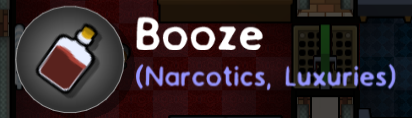
Booze fuels alcohol addiction. It is mainly found in staff areas, so make these staff-only where possible. The main risk is with the psychologist's office, so limit access to this, use CCTV, and potentially place a guard in the room.


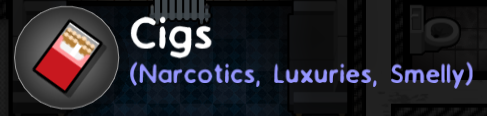
Cigs fuel general addictions. They are mainly found in staff areas, so use guidance as above.


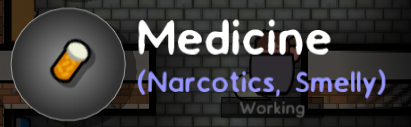
Medicine fuels drug addiction. Medicine is only found in the Infirmary or deliveries. You may need lots of resources focussed on the Infirmary, including dog handlers.


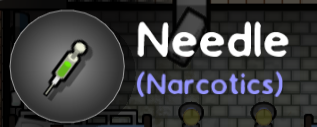
Needle fuels drug addiction. Needles are only found in the Infirmary or deliveries. Guidance as above.


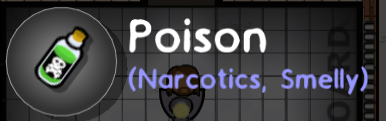
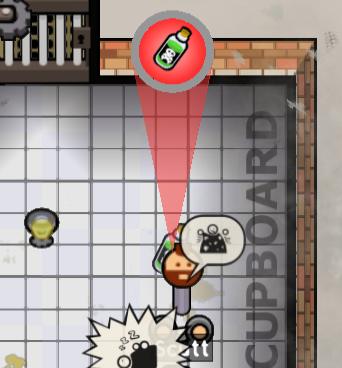
Poison fuels drug addiction. Poison is found in a variety of places in the prison, most importantly cleaning cupboards. This presents a challenge, as most of your prisoners have a legitimate reason to access this (for employment, which improves reform and general needs). You may choose to upgrade the security grading of prisoners with active drug addiction so that they can no longer access this particular source (such as to maximum security).

Screening
Of the above 5, 3 are "smelly" (cigs, medicine, poison). This means that they are quite easy for dog handlers to sniff out, making dog handlers a good strategy to counteract this type of contraband. Dog handlers can be placed in areas where contraband is stolen from, or on the wings.

Deliveries
Lots of drug-related contraband is delivered to the prison, and will need to be screened out of deliveries. Not every delivery is searched by a guard.
  • Use metal detectors to catch needles. Delivered goods should pass through a metal detector at least twice (to avoid the risk of false negatives, which do rarely occur with metal detectors).
  • Use dog handlers to sniff all arriving goods (the deliveries area should not be too big, and the number of dog handlers adequate to handle this).

Searches
It is important to search for contraband. There are lots of contraband strategies, including the above use of metal detectors and dog handlers. You can also use cell and cell block searches (ordered manually), or shakedowns. Many drugs may be stored in toilets, and so toilet searches may prove fruitful (though not always, and drugs are often not stored for long periods as they are instead used quickly).
Overdoses and how to respond
Overdoses are inevitable in a prison with enough inmates, especially in low-security conditions where access to contraband may (naturally) be higher.

Notification
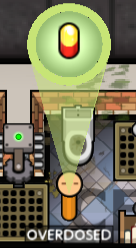
You will be automatically notified of all overdoses in the prison with the yellow warning symbol seen above. It is sensible to have good supervision of your prisoners (either by extensive guard patrol or by constant CCTV) so that you can quickly identify and click on the affected prisoner, allowing you to take actions. You should respond to each notification, no matter how tedious it may get with multiple notifications.

Response speed
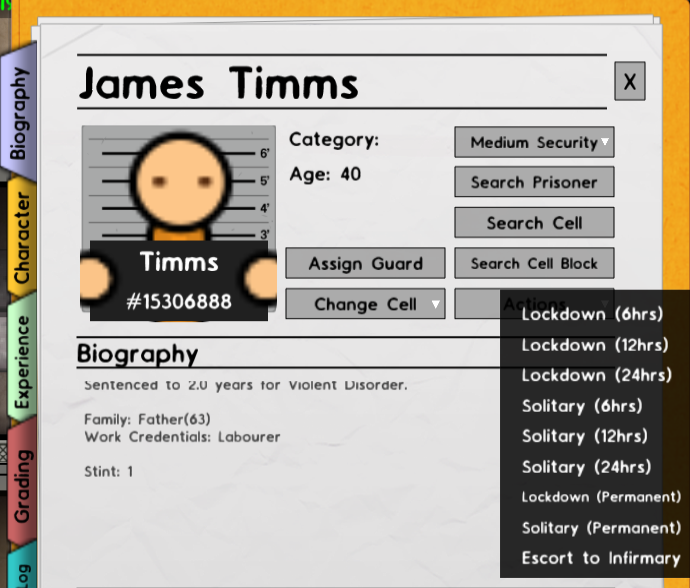
By default, available guards will respond to the overdose and "Store Prisoner in Medical Bed", a non-urgent task done at a normal speed. This risks death. When you click on the inmate, you should be presented with their tab. Within the "Biography" tab, select "Actions" for the prisoner, and select "Escort to Infirmary". This will get a priority guard response, and the guard will be about twice as fast getting them to the infirmary. This reduces death rates substantially.

Staffing and deployment
The critical chain to survival is:
  • an available guard arriving to the overdosed prisoner (you need enough guards, and you will find that response times and death rates increase when your guards are stretched thin (such as in a riot))
  • the guard's movement speed (influenced by how well-rested they are and room temperature
  • floor movement speed (a serious consideration when you are choosing your flooring)
  • proximity of the infirmary (infirmaries should be close to the centre of the prison, minimising walking distance)
  • space in the infirmary (you will need spare beds)
  • doctor availability (use "Deployment" to ensure that there is always a doctor in the infirmary, and hire additional doctors so that not all of them are on cell-visits or teaching programs at any given time)

After
it is sensible to search the prisoner and their cell after an overdose. This will rid them of any further contraband with which they may overdose. Punishment should not be too extensive, as this can disrupt participation in reform programs that are better for them in the long-term.

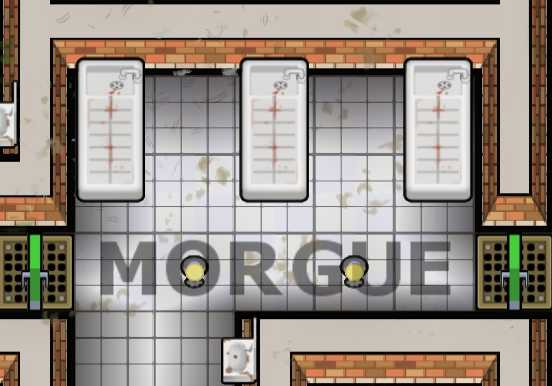
No matter how good you are, you may still experience an overdose death occasionally. It is sensible for all prisons to have a small morgue for storing bodies whilst they wait to be loaded onto hearses.
Summary
This guide has given an overview of alcohol and drugs in Prison Architect.
  • Be aware of how drugs and alcohol can cause serious problems to you financially, logistically, and practically.
  • Invest in reform programs, ensure that buildings are optimised, and make sure that prisoners can get to them
  • Reduce contraband, considering the role of dog handler and metal detector screening, altering security grading, and search policy.
  • Respond to overdoses promptly to prevent death, ensuring that your prison and staffing are arranged to reduce weak links in the chain of survival.